

01
OVERVIEW
Making complex B2B experiences simpler
I worked as the UX Designer within the APM Terminals product team, working across two main areas: improving the Truck Appointment System, a B2B product used by trucking companies to manage terminal visits, and contributing to the Maersk Design System by adapting and expanding it for APM Terminals.
My work combined product design, user research, workshops, design systems and close collaboration with Product Owners, developers and business stakeholders.
Role
UX Designer · Product Designer
UX Designer · Product Designer
Year
2024-2026
2024-2026
Focus
UX/UI · B2B · Design Systems · User Research
UX/UI · B2B · Design Systems · User Research
02
Challenge
APM Terminals operates within the wider Maersk organisation, but has its own brand, customers and highly specialised operational environment.
This created two connected design challenges.
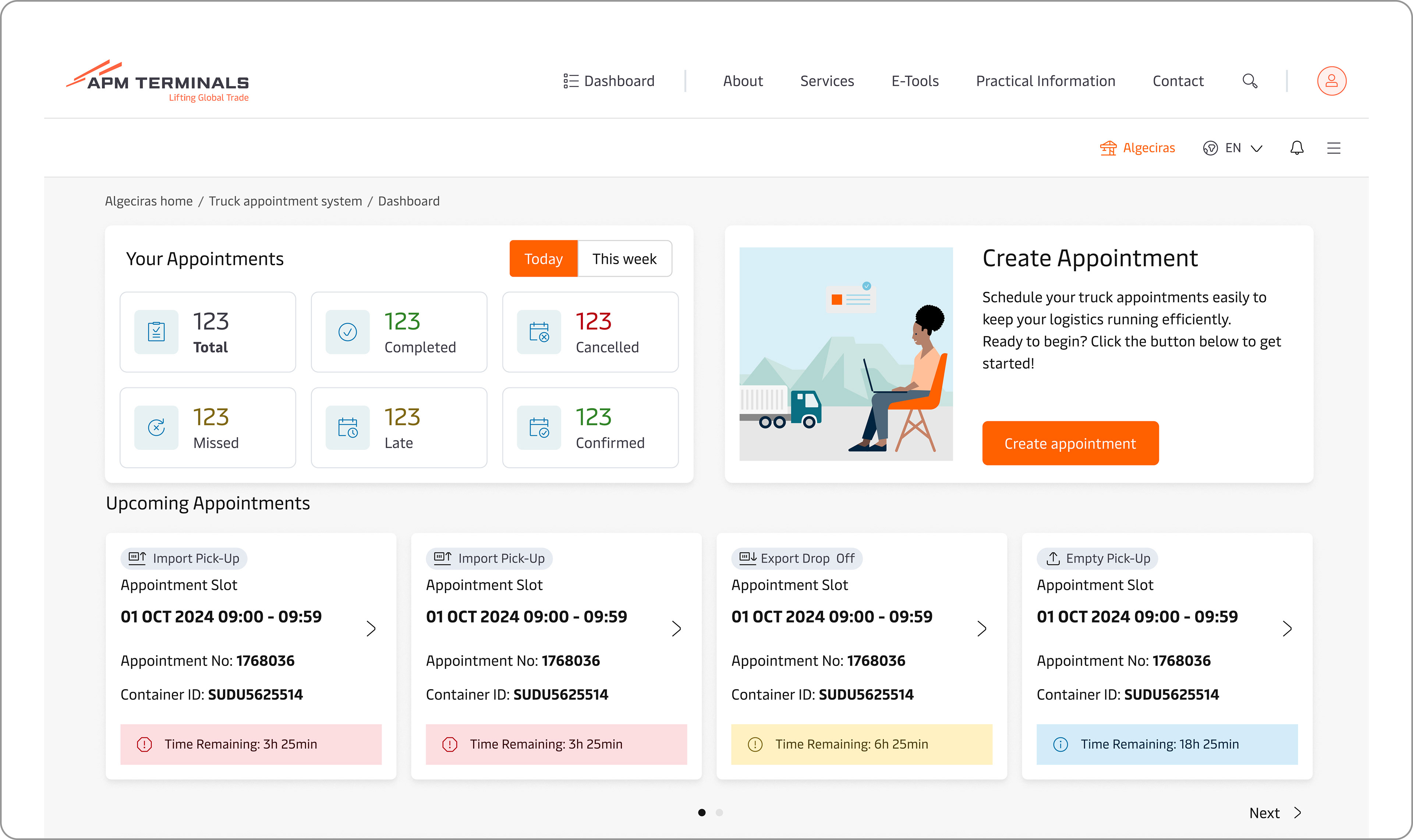
For the Truck Appointment System, the challenge was to simplify a complex B2B workflow used to manage truck visits to terminals. Users need to select containers, manage appointments and time slots, and deal with operational requirements, often while working in a fast-moving environment where clarity and speed matter.
For the Design System, the challenge was broader: how could APM Terminals have a distinct identity while still feeling part of the wider Maersk ecosystem?
APM Terminals wasn't simply another product within the Maersk brand. It had its own customers, terminology, operational context and visual identity. The challenge was therefore not to create something separate, but to find the right balance between consistency and independence.
The solution was to share the foundations, not the expression.
The Maersk Design System provided a common foundation, while APM Terminals could express its own brand through its visual language, components and patterns. I contributed to this adaptation by extending the system with new components and specialised iconography for the terminal business, allowing APM Terminals to feel distinctly its own while remaining connected to the wider Maersk ecosystem.
This created two connected design challenges.
For the Truck Appointment System, the challenge was to simplify a complex B2B workflow used to manage truck visits to terminals. Users need to select containers, manage appointments and time slots, and deal with operational requirements, often while working in a fast-moving environment where clarity and speed matter.
For the Design System, the challenge was broader: how could APM Terminals have a distinct identity while still feeling part of the wider Maersk ecosystem?
APM Terminals wasn't simply another product within the Maersk brand. It had its own customers, terminology, operational context and visual identity. The challenge was therefore not to create something separate, but to find the right balance between consistency and independence.
The solution was to share the foundations, not the expression.
The Maersk Design System provided a common foundation, while APM Terminals could express its own brand through its visual language, components and patterns. I contributed to this adaptation by extending the system with new components and specialised iconography for the terminal business, allowing APM Terminals to feel distinctly its own while remaining connected to the wider Maersk ecosystem.


03
Two areas of focus
01 — Simplifying complex B2B workflows
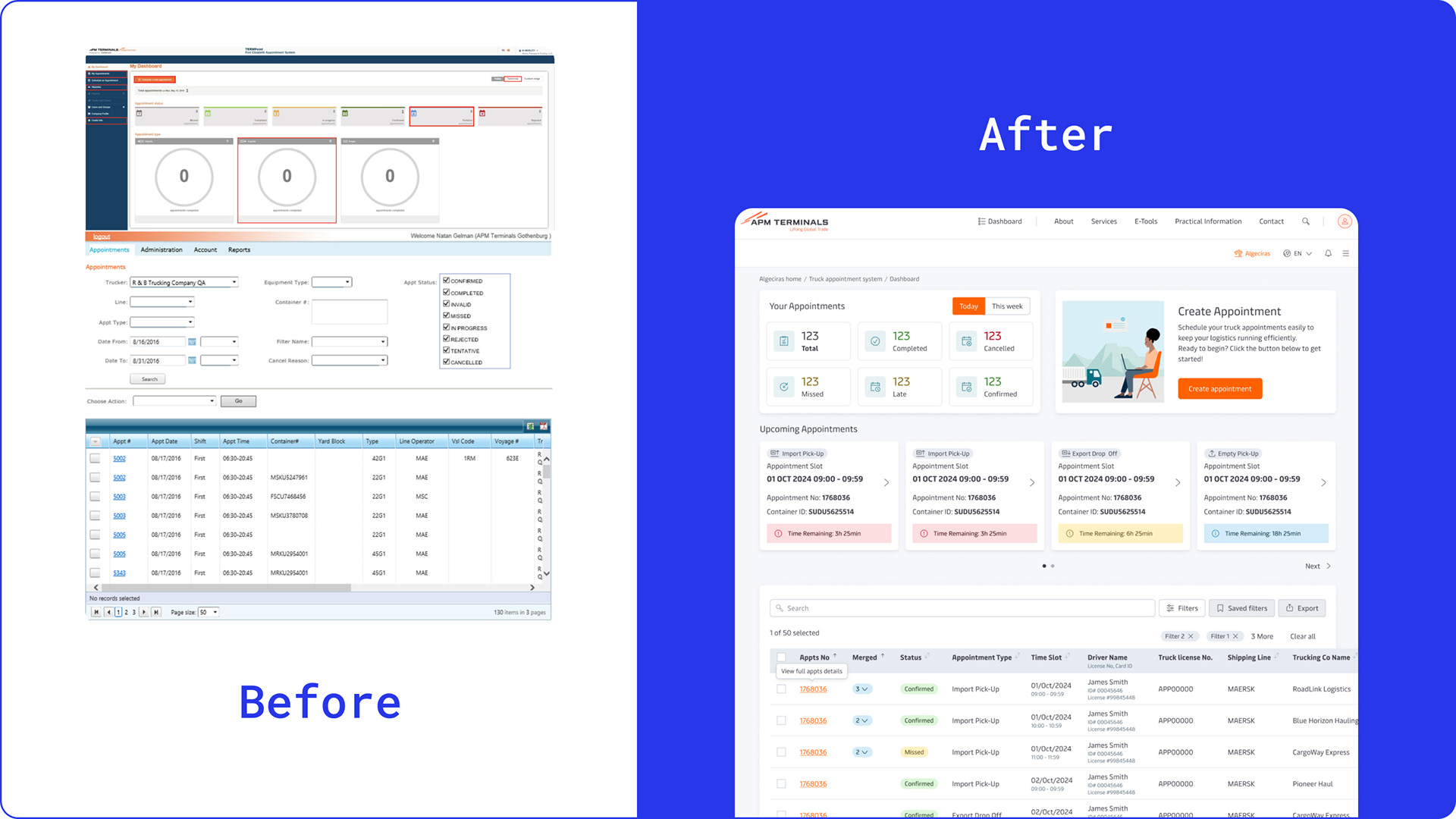
As the UX Designer for TAS, I worked with the product team to make the appointment flow simpler, faster and easier to understand for trucking companies and drivers.
02 — Extending a global design language
Alongside TAS, I contributed to the Maersk Design System by adapting components for APM Terminals and creating new patterns and iconography for the specific needs of the terminal business.
As the UX Designer for TAS, I worked with the product team to make the appointment flow simpler, faster and easier to understand for trucking companies and drivers.
02 — Extending a global design language
Alongside TAS, I contributed to the Maersk Design System by adapting components for APM Terminals and creating new patterns and iconography for the specific needs of the terminal business.
04
Truck Appointment System (TAS)
Simplifying a complex B2B experience
The Truck Appointment System (TAS) is a B2B portal used by trucking companies to book and manage appointments for trucks visiting APM Terminals.
Users need to work with containers, appointment types, time slots and operational requirements, often in a fast-moving environment where clarity and speed matter.
As the UX Designer for TAS, I worked closely with the Product Owner, developers and business stakeholders to simplify the appointment flow and make it easier and faster to complete.
We used user interviews and A/B testing to understand where users experienced friction and to validate different solutions. Rather than looking only at individual screens, we also wanted the wider product team to develop a shared understanding of the people using TAS and the context in which they work.
The Truck Appointment System (TAS) is a B2B portal used by trucking companies to book and manage appointments for trucks visiting APM Terminals.
Users need to work with containers, appointment types, time slots and operational requirements, often in a fast-moving environment where clarity and speed matter.
As the UX Designer for TAS, I worked closely with the Product Owner, developers and business stakeholders to simplify the appointment flow and make it easier and faster to complete.
We used user interviews and A/B testing to understand where users experienced friction and to validate different solutions. Rather than looking only at individual screens, we also wanted the wider product team to develop a shared understanding of the people using TAS and the context in which they work.

A workshop with the global TAS team
Together with the Product Lead, I designed and facilitated a two-day workshop with the global TAS team.
We started by defining what success looked like for our customers, the business and the terminal. We then took on different roles across the experience, including truck drivers, dispatchers and terminal workers, to explore their goals, frustrations and constraints.
On the second day, we mapped the customer journey from end to end, creating a shared view of the different stages, pain points and opportunities across the experience.
We also brought development into the process, looking at technical requirements and constraints to make sure the solutions we explored could work in practice.
On the second day, we mapped the customer journey from end to end, creating a shared view of the different stages, pain points and opportunities across the experience.
We also brought development into the process, looking at technical requirements and constraints to make sure the solutions we explored could work in practice.
05
A design system for APM Terminals
One system, different brand needs
APM Terminals needed to feel like APM Terminals.
At the same time, its digital products needed to remain recognisable as part of the wider Maersk ecosystem.
Rather than creating a separate design language, we worked from the existing Maersk Design System and adapted it to the needs and personality of APM Terminals.
The challenge was to find the balance between brand distinction and a shared foundation.
APM Terminals needed to feel like APM Terminals.
At the same time, its digital products needed to remain recognisable as part of the wider Maersk ecosystem.
Rather than creating a separate design language, we worked from the existing Maersk Design System and adapted it to the needs and personality of APM Terminals.
The challenge was to find the balance between brand distinction and a shared foundation.
Adapting the system
From global foundations to terminal-specific needs
I worked with stakeholders, business needs and user requirements to understand where the existing system worked for APM Terminals and where it needed to evolve.
I adapted existing components and created new ones where the terminal context required something more specific.
One of the biggest areas was iconography.
APM Terminals has a highly specialised operational environment, with equipment, processes and concepts that don't exist in many other Maersk products.
I designed a new set of icons to represent these specific needs while keeping them visually aligned with the wider Maersk Design System.
From global foundations to terminal-specific needs
I worked with stakeholders, business needs and user requirements to understand where the existing system worked for APM Terminals and where it needed to evolve.
I adapted existing components and created new ones where the terminal context required something more specific.
One of the biggest areas was iconography.
APM Terminals has a highly specialised operational environment, with equipment, processes and concepts that don't exist in many other Maersk products.
I designed a new set of icons to represent these specific needs while keeping them visually aligned with the wider Maersk Design System.
Designing beyond one product
The work didn't stay within APM Terminals.
The new icons became part of the Maersk Design System library, making them available to other teams across the organisation.
This meant that specialised APM Terminals needs could contribute back to the global system, rather than becoming isolated solutions.
The icons have since been reused across different products, extending the library while keeping the wider system consistent.
The work didn't stay within APM Terminals.
The new icons became part of the Maersk Design System library, making them available to other teams across the organisation.
This meant that specialised APM Terminals needs could contribute back to the global system, rather than becoming isolated solutions.
The icons have since been reused across different products, extending the library while keeping the wider system consistent.


06
Decisions
01 — Designing for real-world complexity
Both TAS and the Design System had to work within complex operational and technical environments.
For TAS, this meant simplifying complex workflows without losing the business logic behind them.
Both TAS and the Design System had to work within complex operational and technical environments.
For TAS, this meant simplifying complex workflows without losing the business logic behind them.
For the Design System, it meant adapting a global system to the specific needs of APM Terminals while working within its existing foundations.
In both cases, I focused on understanding the complexity first, then finding ways to make it clearer, more usable and easier to scale.
In both cases, I focused on understanding the complexity first, then finding ways to make it clearer, more usable and easier to scale.
02 — Designing beyond the immediate solution
I looked for solutions that could be useful beyond the individual screen, feature or product.
In TAS, this meant working with the wider team to build a shared understanding of users and the customer journey.
I looked for solutions that could be useful beyond the individual screen, feature or product.
In TAS, this meant working with the wider team to build a shared understanding of users and the customer journey.
In the Design System, it meant creating reusable components and iconography that could be used beyond APM Terminals and contribute back to the wider Maersk system.
07
Outcome
A clearer product experience
TAS evolved through user research, testing and closer collaboration across product, business and development, helping simplify the experience for the people managing and making terminal appointments.
A design system that works across brands
The Maersk Design System was extended to support APM Terminals' specific brand and operational needs, while keeping it connected to the wider system.
TAS evolved through user research, testing and closer collaboration across product, business and development, helping simplify the experience for the people managing and making terminal appointments.
A design system that works across brands
The Maersk Design System was extended to support APM Terminals' specific brand and operational needs, while keeping it connected to the wider system.
From APM Terminals to Maersk
New components and specialised iconography created for APM Terminals were added to the global Design System, making them available for reuse across Maersk.
New components and specialised iconography created for APM Terminals were added to the global Design System, making them available for reuse across Maersk.
Designing for a specific business while contributing to a global ecosystem